How Far Can a Van Drive for 10 Cents Cheaper Diesel? The Saving Ends at 27.6 Extra Kilometres
Ten cents per litre sounds decisive when diesel is expensive. A 60-litre fill at that discount keeps €6 in the business before the van moves one metre to reach it.
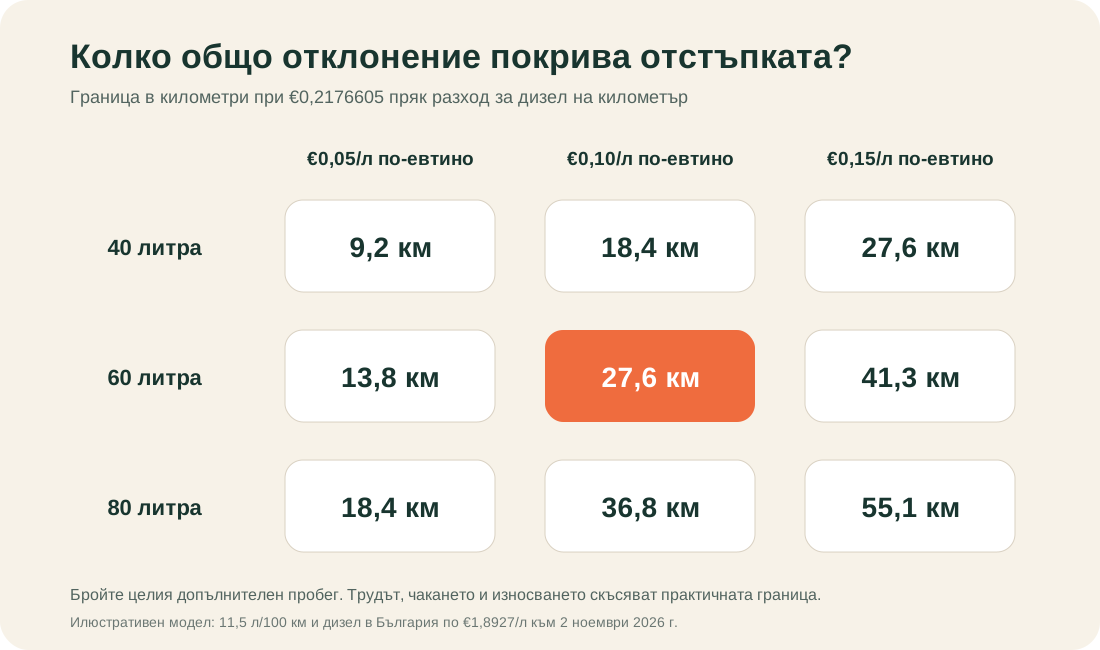
The route can consume the saving. At Bulgaria's latest official diesel price, a van using 11.5 l/100 km burns €0.218 in diesel for every additional kilometre. The €6 survives 27.6 extra kilometres. Kilometre 28 begins to spend more fuel than the discount returns.
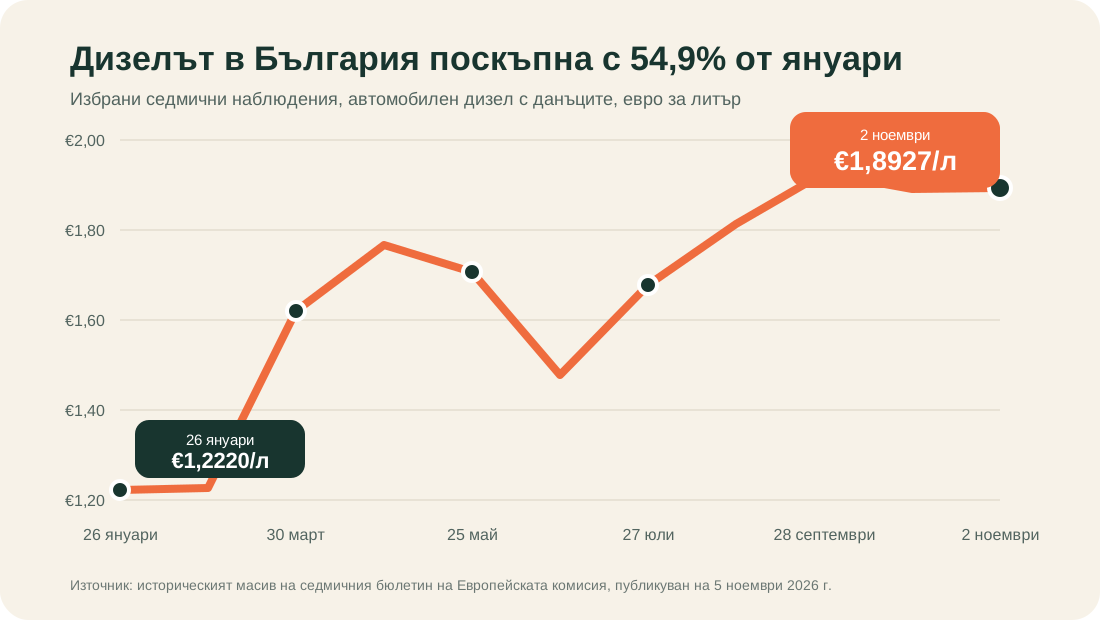
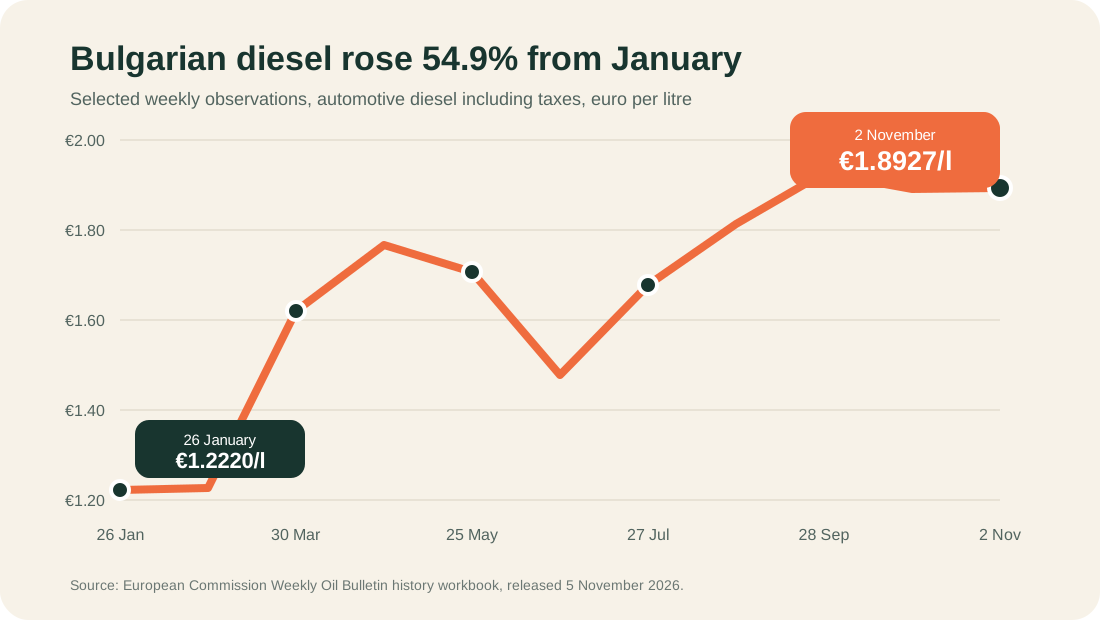
Bulgarian diesel is 54.9% above the January observation
The European Commission bulletin published on 5 November reports Bulgarian automotive diesel including taxes at €1.8927 per litre for 2 November. The official history workbook recorded €1.2220 on 26 January. The rise between those two weekly observations is 54.9%.
A changing pump price changes the cost of the detour. The discount can change too. That is why a remembered rule such as “drive up to 20 km for cheaper fuel” has little value without its assumptions.
One extra kilometre costs €0.218 in diesel for this van
Use the vehicle's measured average, including the type of work it is doing. For an illustrative van at 11.5 l/100 km:
direct diesel per km = 11.5 ÷ 100 × €1.8927 = €0.2176605
The break-even formula is simple:
break-even detour = litres bought × discount per litre ÷ direct fuel per km
At 12 extra kilometres, direct diesel costs €2.61 and €3.39 of the discount remains. At 30 extra kilometres, diesel costs €6.53 and the trip has already turned the advertised discount into a €0.53 direct-fuel loss.
Fill size and discount move the limit
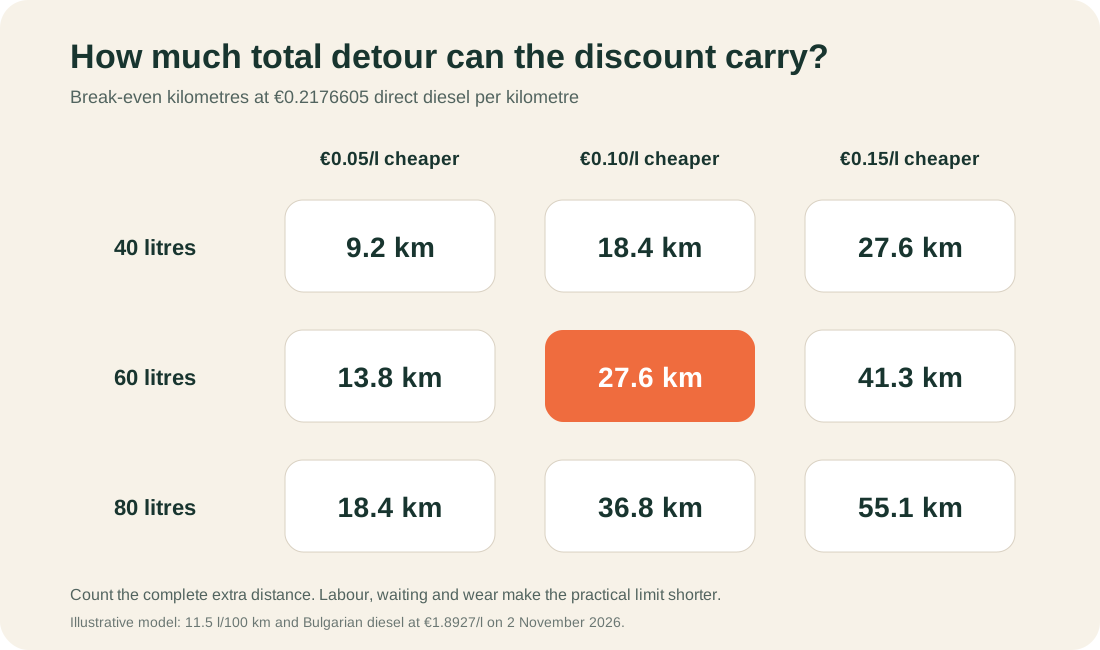
The matrix is a fuel-only ceiling. Driver time, waiting at the pump, tyres, maintenance and depreciation shorten the practical limit. If the vehicle does not need a full fill, use the litres it will actually buy. Inflating the volume inflates the apparent saving.
A fuel stop can add 12 km or sit inside the route
Consider 12 compatible deliveries whose useful route covers 90 km. A preferred station outside the corridor adds 12 km, taking the day to 102 km. Moving the refuelling stop to a station already on the delivery corridor removes those 12 km.
| Route plan | Completed deliveries | Total distance | Direct diesel | Fuel per delivery |
|---|---|---|---|---|
| Fuel detour added | 12 | 102 km | €22.20 | €1.85 |
| Station on the delivery corridor | 12 | 90 km | €19.59 | €1.63 |
| Denser compatible route | 16 | 96 km | €20.90 | €1.31 |
The 12 km removal is worth €2.61 in direct diesel before any pump discount is counted. The denser route then adds 6 km and four compatible deliveries. Total diesel rises by €1.31 compared with the 90 km route, while direct fuel per completed delivery falls by 20.0%.
That 20.0% describes cost density. Revenue, loading, promised time, capacity, customer access and service minutes still decide whether the four deliveries improve profit.
Put five fields beside every fuel receipt
- Record litres and actual unit price. The receipt establishes the cash paid and the volume behind the claimed discount.
- Measure vehicle consumption. Use litres and odometer distance over a representative period. Separate city work when it behaves differently.
- Capture the complete added distance. Compare the delivery route with and without the preferred station. Count the return to useful work.
- Record stop minutes. A fuel-only saving can disappear through a queue or a badly timed diversion even before wear is considered.
- Review fuel per completed delivery. This exposes whether route density is improving while total fuel changes.
The owner can then set a live threshold for each vehicle and fill. The calculation should be repeated when the pump price, discount, consumption or planned corridor changes.
Where MileCut fits
MileCut lets an owner upload a CSV, XLS or XLSX delivery list, review all stops together, select one to five couriers, adjust the proposed allocation and create Google Maps links. Plan the delivery corridors first, then check whether a preferred station lies along work the van already needs to complete.
MileCut does not read station prices, add fuel stops automatically, measure vehicle consumption or calculate this break-even. The dispatcher remains responsible for current prices, safe refuelling, range, opening hours, vehicle suitability and every promised delivery time.
Sources and limits: European Commission Weekly Oil Bulletin, its price-history workbook released 5 November 2026, and the MileCut guide. Sources checked 9 November 2026. The price history uses selected weekly observations. Monthly averages fall outside this calculation. The discount, fill volume, consumption, route distance and delivery counts are illustrative. The cost model covers direct diesel only. Use current receipts, odometer readings and completed-route records for business decisions.
Plan the delivery corridor before the fuel detour.
Group compatible stops, compare route distance and review the allocation before the vans leave.